The Core Difference: Inside-Out vs Outside-In
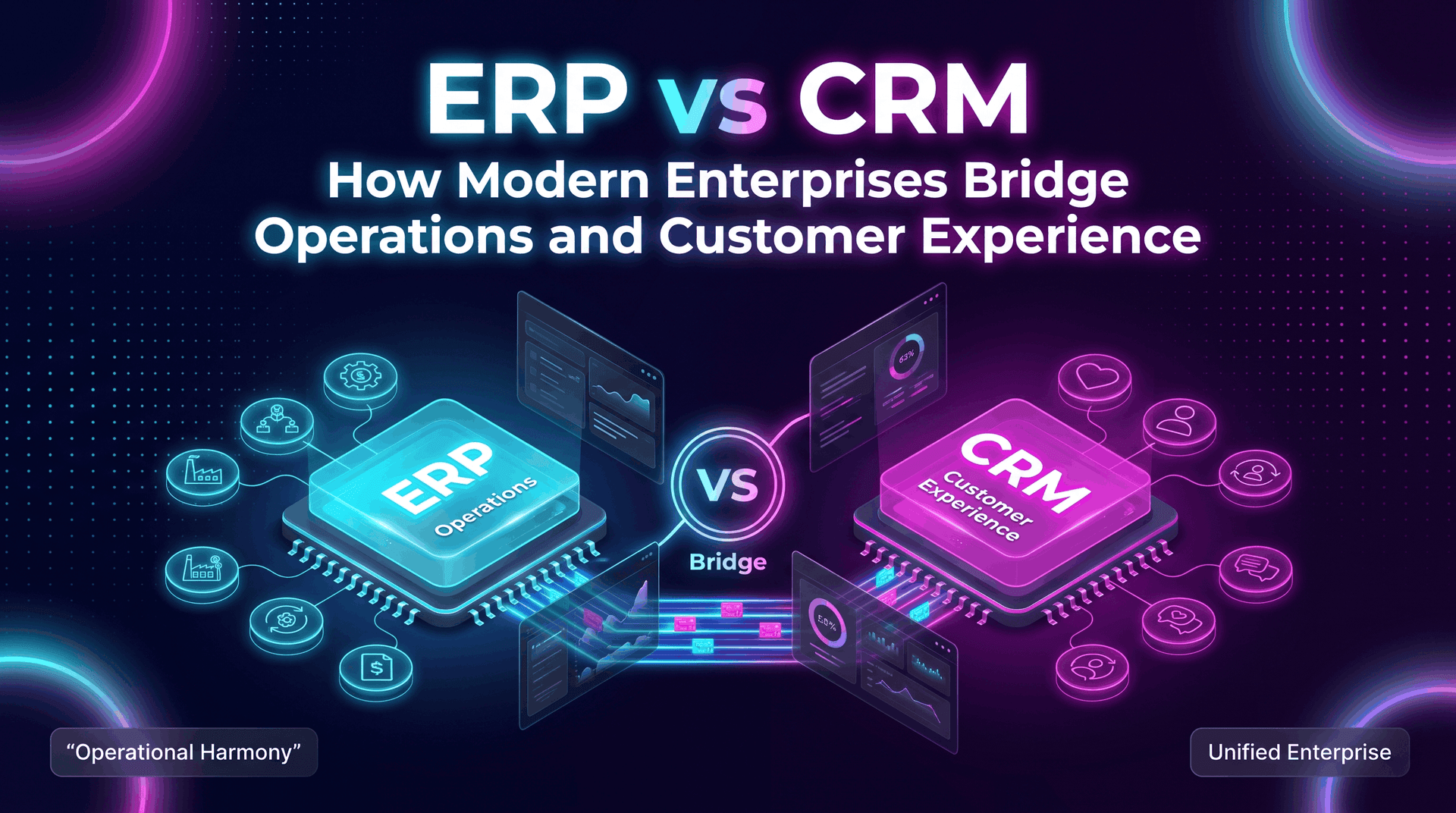
At the most fundamental level, an Enterprise Resource Planning (ERP) platform focuses on the internal mechanics of a company — financials, supply chains, inventory, human resources, and manufacturing. A Customer Relationship Management (CRM) platform, by contrast, focuses entirely outward — managing lead pipelines, customer interactions, sales funnels, and support ticketing. While businesses often deploy them separately, true scaling occurs when both systems speak fluently to one another.
The Risk of Siloed Operations
When your sales team operates exclusively in CRM without visibility into inventory balances or customer credit limits stored in the ERP, promises are made that fulfillment teams cannot keep. Conversely, if accounting teams invoice in ERP without visibility into contract amendments logged in CRM, billing disputes arise. Integrating Dynamics 365 ERP and CRM eliminates double entry, eliminates discrepancies, and speeds up cash collection cycles.
How Unified ERP and CRM Drives Revenue Growth
When an account manager opens a client profile in a unified environment, they see historical order volume, active support tickets, real-time shipment tracking, and pending receivables simultaneously. This 360-degree clarity allows teams to proactively address customer frustrations, upsell at the optimal lifecycle stage, and automate the entire quote-to-cash process with zero manual intervention.
FlutterFlirt’s Connected Implementation Blueprint
At FlutterFlirt, we engineer seamless bidirectional data synchronization between Dynamics 365 Finance & Operations / Business Central and Dynamics 365 Customer Engagement. By utilizing Microsoft Dataverse and Azure integration pipelines, your business gains a resilient, single source of truth across all operational and revenue touchpoints.

FlutterFlirt Team
Consulting & Technology team